Florida roofing advertising rules: what your insurance-claim ads have to say before they run
Florida roofing advertising rules for insurance-claim ads: the disclaimer 489.147 requires, what you can't offer, and how to run ads that stay legal.
By Ryan McKeel · JUICED Media, Clearwater FL
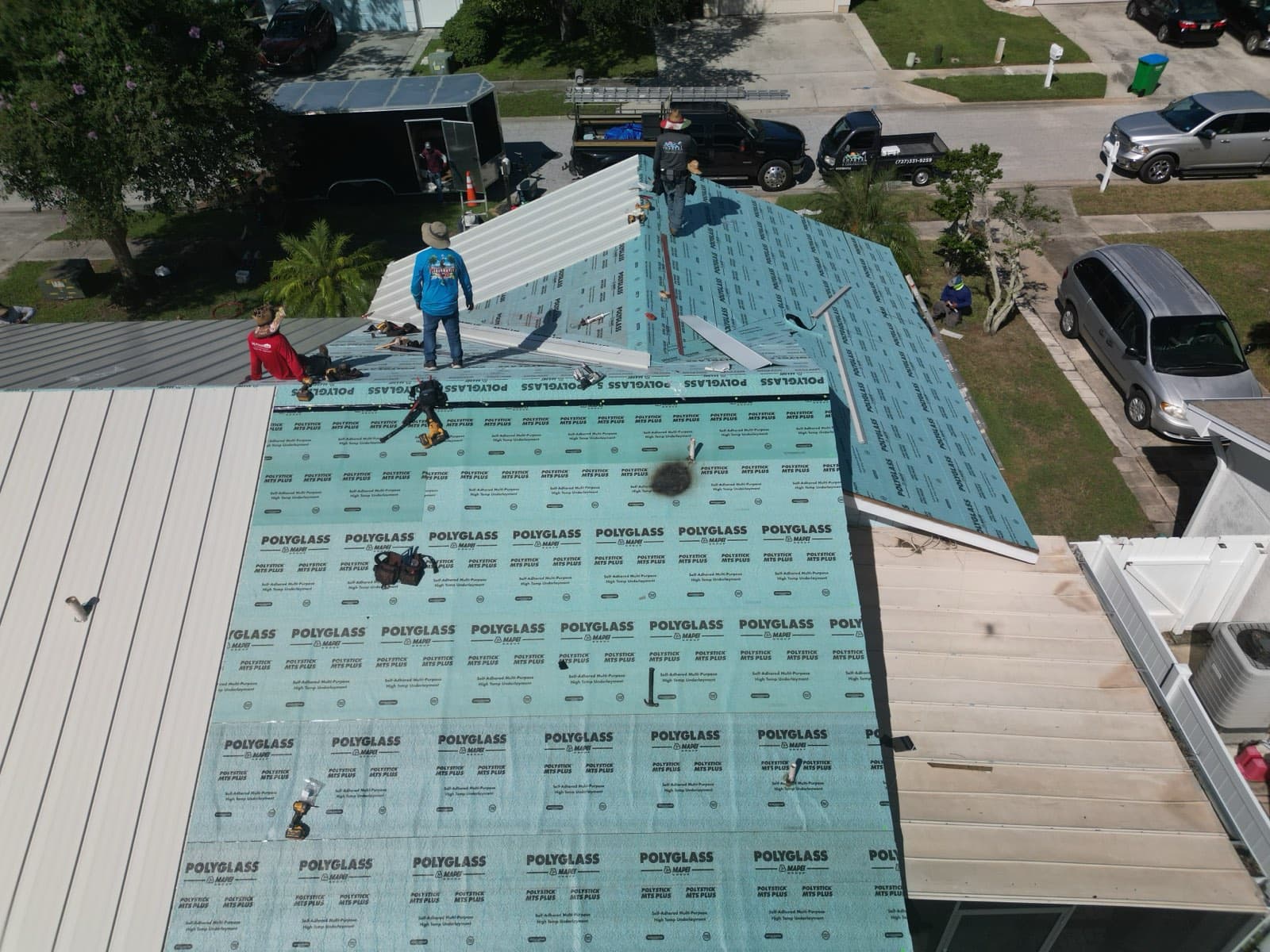
Florida roofing advertising rules don't stop you from mentioning insurance. They stop you from mentioning it without a disclaimer. Any ad that nudges a homeowner to call you about a roof damage claim has to carry specific language, in type large enough to read, or it's a prohibited advertisement worth up to $10,000 per violation.
Most roofing ads in Tampa Bay aren't illegal. Plenty are one careless line away.
The short answer
- Florida statute 489.147 covers any written or electronic ad that encourages a homeowner to contact a contractor or public adjuster to file a roof damage claim.
- Those ads need a three-part disclaimer, at least 12 point and at least half the size of the biggest text in the ad.
- You can't offer anything of value for an inspection or a claim, and you can't touch the deductible.
- Ads about retail replacement, with no claim angle, don't trigger the disclaimer.
- Up to $10,000 per violation, and your canvassers' mistakes count as yours.
This is how we read the statute when we build roofing campaigns. It isn't legal advice. If a line in your ad is borderline, the person to ask is your attorney, not your marketing company.
What Florida roofing advertising rules actually say
The law is section 489.147 of the Florida Statutes. It was first passed in 2021 as an outright ban on written ads encouraging roof claims. A federal judge blocked that version on First Amendment grounds. The legislature rewrote it in 2022, and the rewrite is what applies now: you can say it, but you have to say the rest too.
A "prohibited advertisement" is any written or electronic communication from a contractor that encourages, instructs or induces a homeowner to contact a contractor or public adjuster to make a roof damage claim, unless it states:
- The consumer is responsible for paying any insurance deductible.
- It is insurance fraud, a third-degree felony, for a contractor to knowingly or willfully pay, waive or rebate all or part of a deductible.
- It is insurance fraud, a third-degree felony, to intentionally file a claim with false, incomplete or misleading information.
The statute names door hangers, business cards, magnets, flyers, pamphlets and emails. "Electronic communication" is broad enough that you should assume it covers your Facebook ads, your landing page and your text follow-ups too.
What a compliant roofing ad has to include
The disclaimer has a size rule, and that's where most ads fail. It has to be at least 12 point and at least half as large as the largest text in the ad.
That second half is the trap. If your door hanger says "STORM DAMAGE?" in 72-point type, the disclaimer has to be at least 36 point. Tiny grey text along the bottom edge doesn't count.
Here's how that plays out by format:
| Format | Where the disclaimer goes | Common mistake |
|---|---|---|
| Door hanger or flyer | Front side, at least half the size of the headline | Six-point print on the back |
| Facebook or Instagram image ad | In the image itself, plus the primary text | Only in the primary text, behind "See more" |
| Video ad | Burned-in text on screen long enough to read, plus the caption | Two-second flash at the end |
| Landing page | Near the form, not the footer | Hidden in terms and conditions |
| Email or text follow-up | In the message body | Left off because "they already saw the ad" |
The statute was written with print in mind, so it doesn't say how 12 point converts to a phone screen. Our rule is simple: if the disclaimer isn't at least half the size of your biggest words wherever it's seen, redesign the ad. Arguing about pixels with the licensing board is a bad use of an afternoon.
What you can't offer, even with the disclaimer
The disclaimer only fixes the ad. It doesn't fix the offer. Under 489.147 you can't offer a homeowner a rebate, gift card, cash, coupon, deductible waiver or anything else of value in exchange for:
- Letting you inspect their roof
- Filing a claim for roof damage
You also can't pay or accept a referral fee for work paid with insurance money, interpret policy language or adjust a claim unless you hold a public adjuster license, or hand over a repair agreement without an itemized good-faith estimate.
So these lines are out, no matter how small the print:
- "We'll cover your deductible."
- "$100 gift card with every free inspection."
- "We handle the whole claim for you."
- "Your policy covers this. Let us prove it."
A free inspection by itself is the service, not a bribe for it. "Free inspection" is fine. "Free inspection plus a $50 Visa card" isn't.
Retail and insurance are two different campaigns
This is where the rule actually helps you. A replacement homeowner and a claim homeowner are two different buyers. On a claim, the adjuster's number matters more than your pitch. Most roofing ads blur the two, and they convert worse for it.
Split them:
- Retail campaign. Aging roof, rising premiums, financing, the look of a new metal roof. No mention of claims, so no disclaimer needed. A Tampa roof replacement runs roughly $13,500 to $30,000, and this campaign sells that decision on its own merits.
- Claim campaign. Storm damage, what to photograph, what an adjuster looks for. Disclaimer on every ad, every landing page, every follow-up.
Two campaigns also give you cleaner numbers. You'll know which one books inspections that turn into signed jobs. We cover the creative side of that in Facebook ads for roofers. It's also why cheap-lead campaigns go sideways, as we lay out in why your Facebook ads brought you price shoppers.
Why this matters more after a storm
Hurricane season runs through November 30. This year's NOAA outlook leaned quiet, but one storm through Pinellas or Hillsborough County is enough to change that. When it happens, every roofer from Clearwater to Palm Harbor pushes new ads within 48 hours. That rush is when disclaimers get dropped and a canvasser prints his own door hangers.
The statute treats anyone you pay to solicit as you. That includes employees, commission-only canvassers and outside lead sellers. If a lead vendor runs a non-compliant "storm damage? Get a free roof" ad and sends you the leads, you're the one with the license on the line.
Your contracts carry rules too. Every residential roof contract needs a notice that you can't make the prohibited offers above, plus a bold 14-point notice telling the owner to check coverage with their insurer. Signed within 180 days of a declared state of emergency in the area? The owner gets a 10-day cancellation right, and the contract has to say so. If your ad sends people to a page promising "sign today, we start tomorrow," make sure the paperwork behind it holds up.
Build the compliant version before the storm, not after. Approved creative sitting ready means you launch in an hour, not a day, and you don't cut corners doing it.
A pre-launch checklist for roofing ads
Run every claim-related ad through this before it goes live:
- Does it encourage someone to file a claim or call about one? If yes, it needs the disclaimer.
- Are all three disclaimer statements there, in substance if not word for word?
- Is the disclaimer at least half the size of the largest text, wherever the ad is seen?
- Is anything of value tied to an inspection or a claim? Remove it.
- Does any line promise to handle, interpret or win the claim? Remove it unless you're a licensed public adjuster.
- Do the landing page and follow-up texts carry the same disclaimer?
- Can every canvasser and lead source show you the exact material they're using?
Homeowners can verify your license with Florida DBPR in about thirty seconds. After a storm, a lot of them do. A clean, compliant ad with your license number on it is a trust signal the out-of-state crews can't match.
We build roofing campaigns for contractors across Tampa Bay, including Meta ads, Google Local Services Ads and the video that feeds them. Compliance is built into the creative from the first draft, not bolted on at approval. You can see how we approach the trade on our roofing page.
If you want a second set of eyes on your current roofing ads, send them to us. We'll tell you which ones need the disclaimer and which lines to cut. No pitch attached.
Questions people ask about this
- Can a roofing contractor advertise insurance claims in Florida?
- Yes. Florida does not ban roofers from mentioning insurance claims. Under section 489.147 of the Florida Statutes, any written or electronic ad that encourages a homeowner to contact a contractor or public adjuster to make a roof damage claim must carry a disclaimer, in type at least 12 points and at least half the size of the largest text in the ad. Without that disclaimer, the ad is a prohibited advertisement.
- What disclaimer does a Florida roofing ad need?
- It must state three things: the homeowner is responsible for paying any insurance deductible; it is insurance fraud, a third-degree felony, for a contractor to knowingly pay, waive or rebate all or part of a deductible; and it is insurance fraud, a third-degree felony, to intentionally file a claim containing false, incomplete or misleading information. It applies to door hangers, flyers, business cards, emails and other written or electronic communication.
- Can a roofer offer a free roof inspection in Florida?
- A free inspection on its own is common and generally treated as the service itself. What section 489.147 prohibits is offering a homeowner a rebate, gift card, cash, coupon, deductible waiver or anything else of value in exchange for letting you inspect the roof or for filing a claim. A gift card for an inspection is the problem, not the inspection.
- Can a roofer pay a deductible or offer a deductible discount in Florida?
- No. Paying, waiving or rebating all or part of an insurance deductible is insurance fraud in Florida and a third-degree felony. Offering a deductible waiver in exchange for an inspection or a claim is also a separate violation of section 489.147, with fines of up to $10,000 per violation.
- What is the fine for a prohibited roofing advertisement in Florida?
- A contractor who violates section 489.147 faces disciplinary proceedings from the Construction Industry Licensing Board and a fine of up to $10,000 for each violation. Anything a salesperson, canvasser or paid lead source does on your behalf counts as your own action under the statute.
Want this run for you?
Fifteen minutes. We'll pull your competitors' current ads and tell you what we'd shoot.
Book a Call