Web Design
Contractor websites that load fast, rank, and actually get the call.
Most contractor sites are brochures. They look fine, they load slowly, and nothing on them tells a homeowner what to do next. We build the other kind — SEO-ready, SSL secured, and structured so every screen has one obvious next step.
Starting at$1,499
Fast
Built on Next.js and served from a global edge network. Static pages, compressed images, lazy-loaded video.
SEO ready
Clean heading structure, unique titles and descriptions per page, schema markup, XML sitemap, and a URL structure that scales.
Secure
SSL on every page, no legacy plugin surface, and hosting that patches itself.
Lead generating
A form, a call button, and a reason to use them on every screen — wired to instant SMS and email alerts.
Fast
A contractor's customer is often on a phone with two bars in a driveway. Every second of load time costs conversions, and most template builders ship four times the code they need.
SEO ready
Ranking isn't a plugin you install afterward. It's decided by how the site is built — one H1 per page, crawlable internal links, LocalBusiness and FAQ schema, and pages that actually deserve to exist.
Secure
Most contractor sites get hacked through an out-of-date plugin nobody updated. We don't build on that stack. Nothing to update, nothing to exploit, and the browser never shows a warning next to your name.
Lead generating
A website that looks good and doesn't capture anything is a brochure. Every page has one obvious next step, and the lead hits your phone before the visitor has closed the tab.
The Work
Real sites, live right now.
Switch between desktop, tablet, and mobile. These aren't mockups — they're screenshots of the live sites, and you can click through to either one.
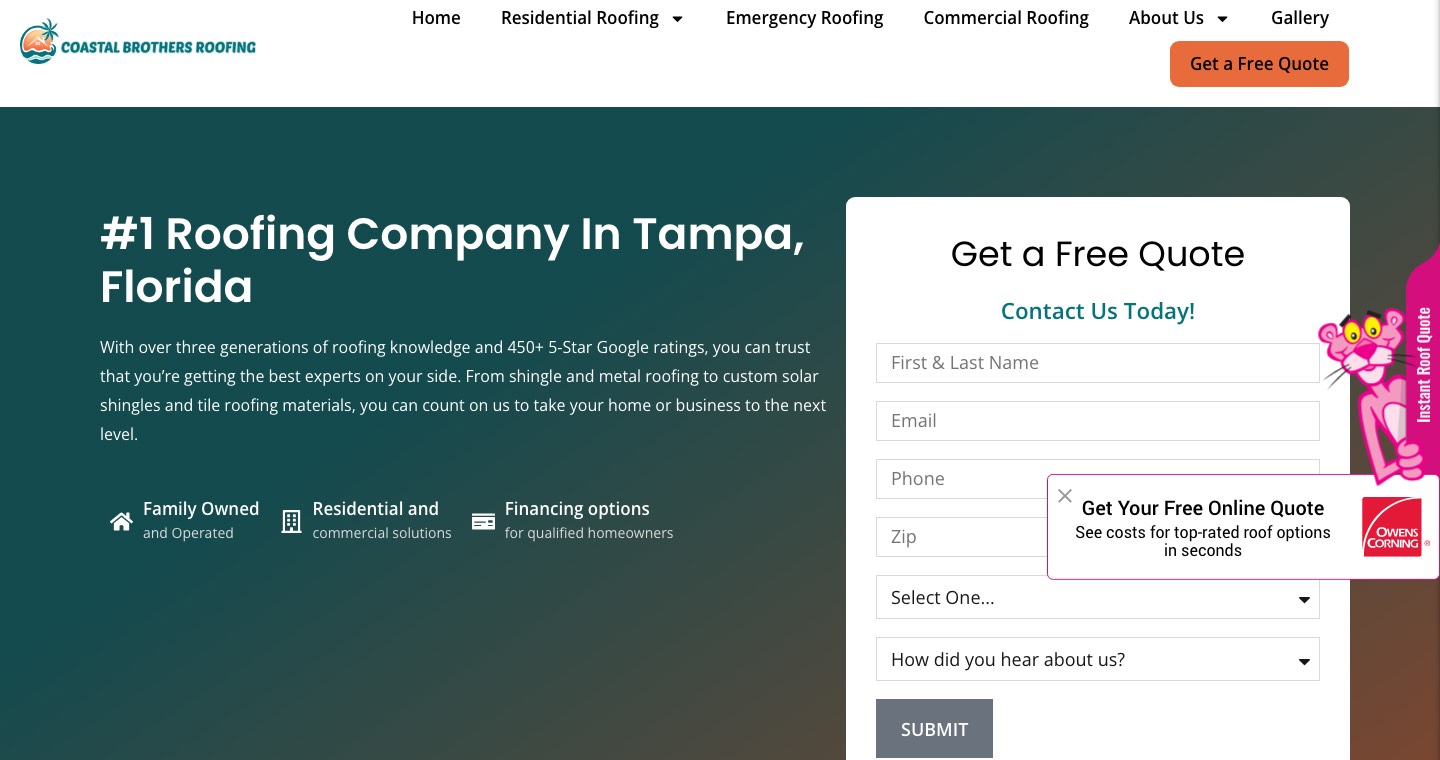
Roofing · Odessa, FL
Coastal Brothers Roofing
Quote form above the fold on every screen size, trust signals in the header bar, and a phone number that stays reachable while you scroll. Built to catch storm-season traffic without making anyone hunt for the next step.
- Lead form above fold
- Local SEO structure
- Meta ads landing path
- Mobile-first
Custom homes & remodeling · Tampa Bay
Keystone Construction Contractors
Higher ticket, longer decision. This one leads with craft instead of a form — portfolio-forward, two clear paths off the hero, and proof stacked before the ask. Different buyer, different structure.
- Portfolio-led layout
- Dual CTA hierarchy
- Service page architecture
- Mobile-first

Why they convert
Design decisions, not decoration.
Every one of these is a choice about how people actually behave on a phone in a driveway — not a style preference.
The next step is never a question
One primary action per screen. Not four buttons competing — one, repeated as they scroll. Choice paralysis kills more contractor leads than bad design ever has.
Proof lands before the ask
Reviews, licence numbers, real job photos, and named towns appear before the form does. People fill out forms for businesses they've already decided are real.
Friction is removed, not decorated
Four fields, not eleven. Nobody abandons a form because it looked plain. They abandon it because you asked for their address before you'd earned it.
The phone number is always reachable
Half your buyers will never fill anything out — they want to call. A sticky call button on mobile routinely outperforms the form it sits next to.
Specific beats polished
"Serving Largo, Seminole and Pinellas Park since 2011" converts better than a stock photo and a tagline. Specificity reads as true, and true is what gets the call.
Speed is a conversion feature
It isn't a technical vanity metric. A slow site loses the visitor before design, copy, or offer ever get a chance to work.
Local clients
Most web designers ask you for photos. We bring a camera.
The difference between a site that feels real and one that feels like a template is almost always the imagery. Stock photos of somebody else's crew do not build trust — people can tell, even when they can't say why.
Because we shoot anyway, Tampa Bay clients get a discounted shoot bundled into the build. Half a day on your job site produces the hero video, the about-us cut, the testimonial, and a library of real photos — all of it captured at once.
Video also keeps people on the page instead of bouncing back to the search results. That matters for conversion first: someone who watches you explain the work is far likelier to call. It also gives Google better engagement signals — worth being precise here, since time-on-page isn't a direct ranking factor no matter what anyone tells you.
Hero section video
Your crew and your work behind the headline, instead of a stock image every competitor also licensed.
About us video
Thirty seconds of you talking does more for trust than a paragraph about your values.
Testimonial videos
A real customer on camera is the most credible thing that can appear on your site. Nothing written comes close.
Process and job site footage
Shows how you work, which is what justifies your price against the cheapest quote.
Real project photography
Your completed jobs, shot properly, replacing the stock library on every service page.
Built in
The parts that do the actual work.
Not every site needs all of these. Most contractors need four or five, and almost none of them have any.
AI chatbot
Answers the common questions at 9pm, qualifies the job, and hands you a booked call instead of a form fill. Wired straight into your CRM.
Live Google review widget
Your real reviews, pulled live and displayed on the page. Updates itself. Nothing to maintain and nothing to fake.
Before / after sliders
The single most persuasive element on a contractor site. Drag the handle, see the work. Costs nothing to add and people actually use it.
Instant lead alerts
Form fill fires a text and an email to your phone in seconds. Speed to lead decides who wins the job more often than price does.
Sticky click-to-call
Pinned to the bottom of every mobile screen. Roughly half your buyers will never fill out a form — they want to call you now.
Booking calendar
Let them pick an estimate slot without a phone tag loop. Syncs to your calendar and confirms by text.
Financing callout
If you offer financing, saying so early changes which jobs you get quoted on. Most contractors bury it on page four.
Service area map
Shows the towns you actually cover, and gives your location pages somewhere to link back to.
How a build runs
- 01
Structure
Pages, URLs, and the conversion path. Decided before a single pixel.
- 02
Copy
Written for your trade and your towns, not filled with placeholder text.
- 03
Build
Fast, responsive, schema-marked, and tested on real devices.
- 04
Wire it up
Forms into your CRM, instant alerts, tracking, and Search Console.
Three to five weeks from kickoff to launch. The bottleneck is usually photos and approvals, not the build.
A site is where the traffic lands.
It works hardest when something is sending people to it.
Questions we get
- How much does a contractor website cost?
- Sites start at $1,499. What moves the number is page count and whether you need location pages — a single-trade contractor is a different build from a multi-service company targeting six cities. We scope it on the call and quote a fixed price, no hourly surprises.
- Can you shoot photos and video for the site?
- Yes, and for local clients we discount the shoot when it's part of a build. That's the advantage of a web designer who also owns cameras — most agencies ask you to send whatever's on your phone.
- How long does it take?
- Typically three to five weeks from kickoff to launch. The bottleneck is almost never the build — it's photos, copy approvals, and getting access to your domain.
- Do I own the website when it's done?
- Yes. The domain, the hosting account, the content, and every photo or video we shoot. If we part ways, none of it holds you hostage.
- Will it actually rank on Google?
- The build gives you the foundation — clean structure, schema, speed, crawlable links. Ranking also depends on your Google Business Profile, reviews, and content over time. Any agency promising a #1 ranking from a website alone is selling something.
- Can you work with my existing site?
- Sometimes. If it's on a modern stack and the structure is sound, improving it is cheaper than replacing it. If it's an outdated template builder with twenty plugins, rebuilding is usually faster and costs less than fixing.
- What happens to leads that come through the site?
- A form fill fires an instant text and email to you, and drops the lead into your CRM with automated follow-up behind it. Speed to lead is the single biggest lever in home services.

Web Design
Let's look at your current site.
Fifteen minutes. We'll run it for speed, check what Google can actually read, and tell you whether it's worth fixing or replacing. No pitch if it's already fine.
- Sites start at $1,499 — you'll know the number before you decide
- We bring a camera, so it launches with your own footage rather than stock
- You own the site, the domain, and the hosting
- Straight answer on fix vs rebuild, even when fix is the cheaper one
Loading the calendar…
Fifteen minutes on Zoom. We'll pull your competitors' current ads before we get on.